Two EU systems affect Australians travelling to Europe, and only one of them has started. The Entry/Exit System (EES) has been fully operational since 10 April 2026: the first time you cross a Schengen border with your Australian passport, border officers take your fingerprints and photo instead of stamping your passport. ETIAS, the EU’s planned travel authorisation, isn’t in effect yet, and there’s nothing to apply for.
This guide explains what happens at the border under the EES, what the EU and Smartraveller have said so far about ETIAS, and how Australia’s visa waiver agreements fit in. For the general rules (passport validity, the 90/180-day rule, Ireland and Cyprus), see Europe visa requirements for Australians.
Key facts
- EES
- In operation. Free. Fingerprints and photo the first time you’re registered; no passport stamps.
- Before you go
- Nothing to do for the EES. Smartraveller says you don’t need to do anything before you arrive at the border.
- Delays
- Smartraveller says the EES has caused delays of up to 4–6 hours at some European airports. Allow extra time between connecting flights.
- ETIAS today
- Not in operation. Applications aren’t open, on the official website or anywhere else.
- ETIAS start date
- No confirmed date. The EU will announce it several months before the launch.
- ETIAS fee (planned)
- €201 (about A$32). Applicants under 18 or over 70 won’t pay it.
- Countries
- ETIAS: the 29 Schengen countries and Cyprus. The EES: the 29 Schengen countries. Ireland uses neither.
Don’t pay anyone for ETIAS now. Smartraveller warns against fraudulent websites claiming to sell ETIAS authorisations, and against websites that say you need to register or pay a fee for the EES before you travel. The official ETIAS website is on europa.eu, the EU’s domain: travel-europe.europa.eu/etias.
Is ETIAS in effect?
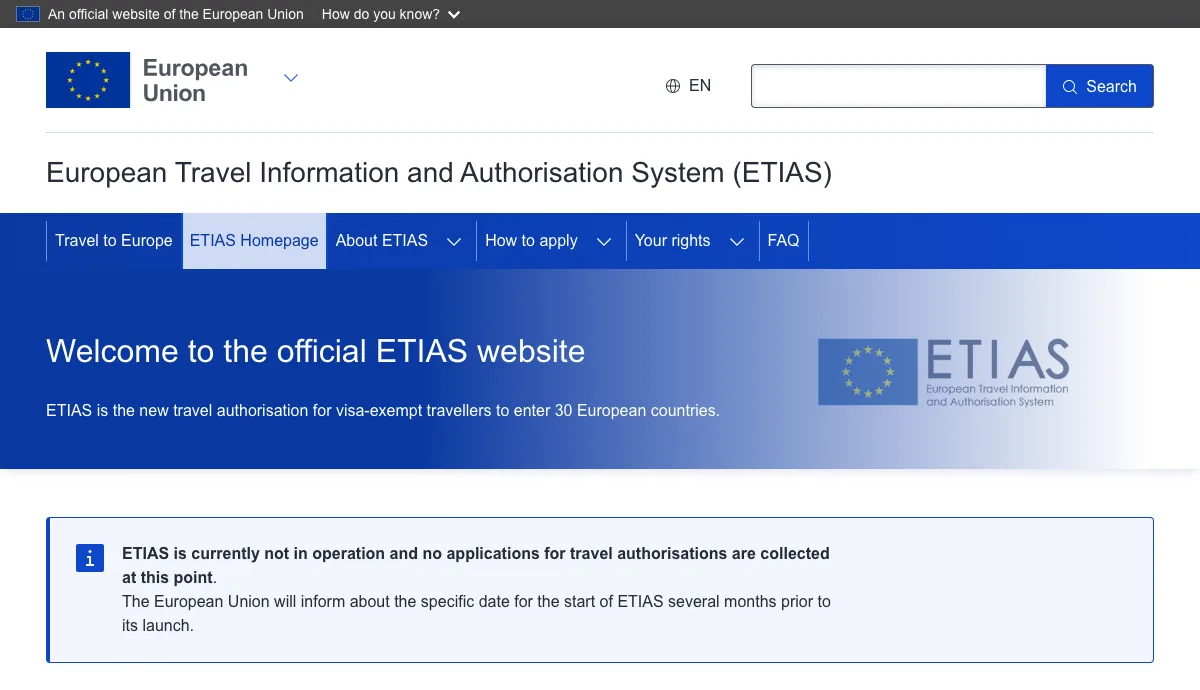
No. The official ETIAS website says ETIAS is ‘currently not in operation and no applications for travel authorisations are collected at this point’. As of 27 November 2026, Smartraveller says the same: applications aren’t open yet.
When does ETIAS start?
There’s no confirmed date. Smartraveller and the EU both say the EU will announce it several months before ETIAS launches.
Earlier, the EU was more specific. In news articles on the official website in July and September 2025, it said ETIAS would be required ‘starting from the last quarter of 2026’, and in December 2025 it said ETIAS would start ‘next year’. As of 27 November 2026, no start date has been announced, so treat any date you see elsewhere as a forecast, not a rule. We’ll update this guide when the EU announces the date.
Do Australians need ETIAS in 2026?
Not at the moment. For a short trip to the Schengen Area, your Australian passport is enough. Once ETIAS starts, Australians will need it: Australia is on the EU’s list of visa-exempt countries whose citizens will have to apply.
What ETIAS will be
ETIAS (the European Travel Information and Authorisation System) will be a travel authorisation for visitors who don’t need a visa, including Australians. It won’t be a visa. It will work like the UK ETA or the US ESTA: an online application before you travel, linked to your passport.
According to the official website:
- Where: 30 countries: Austria, Belgium, Bulgaria, Croatia, Cyprus, Czechia, Denmark, Estonia, Finland, France, Germany, Greece, Hungary, Iceland, Italy, Latvia, Liechtenstein, Lithuania, Luxembourg, Malta, the Netherlands, Norway, Poland, Portugal, Romania, Slovakia, Slovenia, Spain, Sweden and Switzerland. Not Ireland.
- How to apply: only on the official website or the official ETIAS app, once ETIAS starts.
- Fee: €20 (about A$32), non-refundable. Applicants under 18 or over 70 won’t pay it.
- Validity: 3 years, or until the passport you applied with expires, whichever comes first. A new passport will need a new ETIAS.
- Stays: any number of trips of up to 90 days in any 180-day period. Time in Cyprus will be counted separately.
- Processing time: most applications within minutes, and the rest within 96 hours at the latest. If you’re asked for more information or documents, or invited to an interview, it may take up to 30 more days.
- Children: every traveller will need their own ETIAS, including children.
At the airport
The EU says the airline’s check-in staff and border guards will be able to see your ETIAS in the system, so you won’t need a printout. Travel with the same passport you used to apply: if the details don’t match, you’ll be refused boarding and entry.
If you only change planes at a European airport and stay in the international transit area, you won’t need ETIAS. If you leave that area, you will.
Who won’t need ETIAS
- Dual citizens of a participating European country or of Ireland. Smartraveller says you won’t be eligible for ETIAS. Once it starts, you’ll have to enter those countries on the passport of your other country, not on your Australian one. If you don’t have that passport, or it has expired, apply soon, as passport wait times in some countries can be very long. Take your Australian passport too: you’ll need it to return to Australia.
- Holders of a residence permit from one of the ETIAS countries other than Cyprus.
The EES: what happens at the border
The EES is the EU’s digital system for recording when non-EU travellers, including Australians, enter and leave the Schengen Area. It was rolled out gradually over 6 months and has been fully operational at all external Schengen borders since 10 April 2026. It has replaced passport stamps.
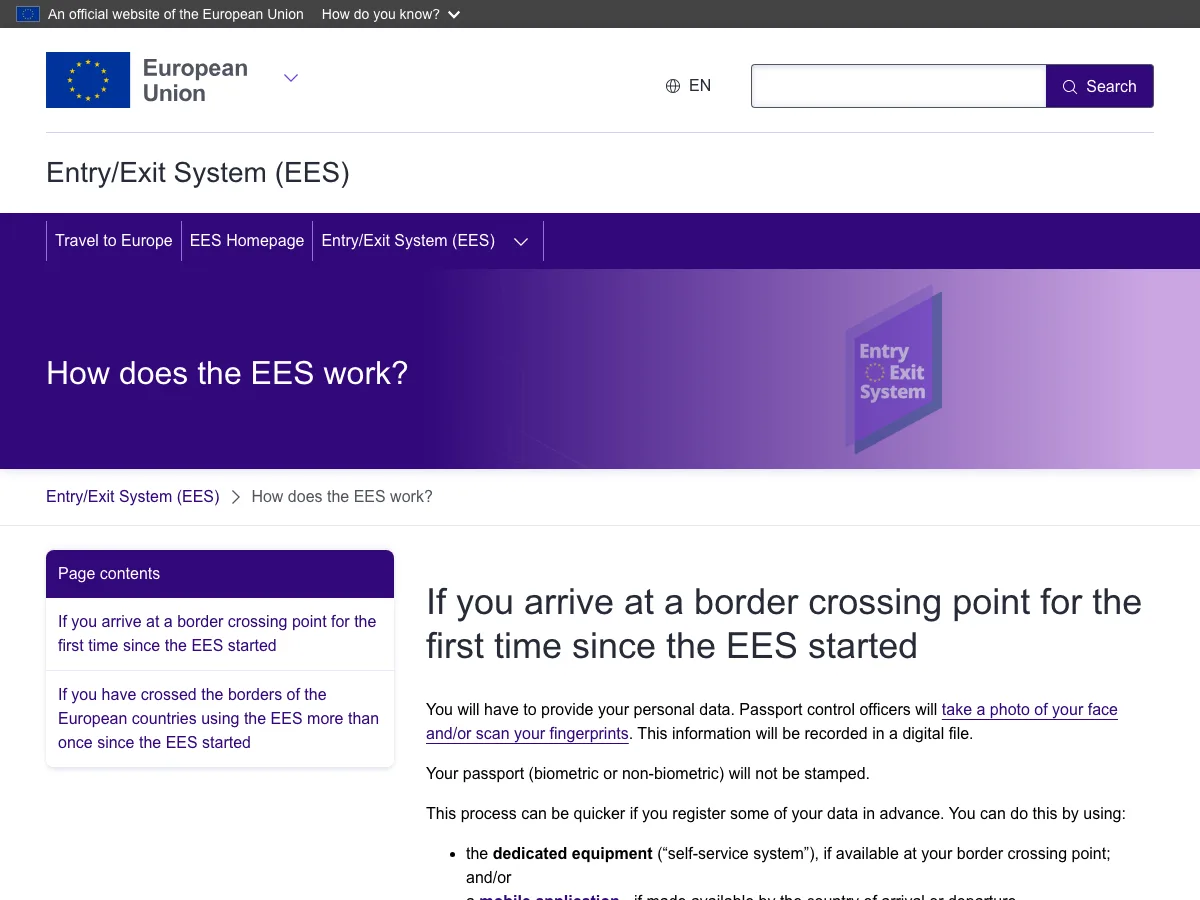
The first time you enter, border officers take your fingerprints and photo, and you answer questions under the Schengen Borders Code. This creates a digital record with your biometric details. Smartraveller says the EES is free and you don’t need to do anything before you arrive at the border.
If you return within 3 years of creating your record, Smartraveller says you’ll only need to give your fingerprints or photo at the border, on entry and exit.
Children under 12 aren’t fingerprinted.
Expect long queues. Smartraveller says the EES has caused delays of up to 4–6 hours at some European airports, and travellers have missed flights. It advises allowing extra time between connecting flights, choosing flexible flight options and arriving well before your flight leaves. Queues for the self-service kiosks are long, so be prepared to stand for some time and take food and water. If you have mobility or health concerns, talk to airport support staff.
Can you register for the EES before you travel?
Not online from home. The EU’s Travel to Europe app lets you enter some details up to 72 hours before you cross the border, but only where the country supports it: as of 16 November 2026, Sweden (passport details, photo and entry questions) and Portugal (entry questions only). It’s optional and doesn’t replace the border check. Smartraveller says the process may be quicker with the app, but you should still be prepared for delays.
The EES now counts your 90 days
The EES doesn’t change how long you can stay: up to 90 days in any 180-day period, counted together across the 29 Schengen countries. What changes is that the system now counts your days. You can check how many you have left with the EU’s online tool or by asking a border officer. The tool doesn’t include time in the Schengen Area before 10 April 2026.
Smartraveller says your EES record is linked to you as a person, not to your passport, so the system will know if you’ve overstayed even if you use a different passport. If you overstay, you may be fined, detained, removed from the country or prevented from returning to the Schengen Area.
Australia’s visa waiver agreements and the EES
Smartraveller lists Australia’s visa waiver agreements with these Schengen countries: Austria, Belgium, Denmark, Finland, Germany, Iceland, Luxembourg, the Netherlands, Norway and Sweden. Smartraveller says some of them let Australians stay beyond the 90-day limit under specific conditions. According to Smartraveller:
- You can only use one of these agreements on top of your 90 visa-free days in the Schengen Area.
- When you first enter the Schengen Area, tell the border officer that you plan to use a visa waiver agreement to stay longer than 90 days.
- Most countries require you to use the agreement at the end of your Schengen travel.
- Each country applies its agreement in its own way, and combining it with the Schengen rules is complex.
Before you rely on an agreement, check with that country’s embassy or consulate in Australia. More on the Europe visa page.
Who isn’t registered in the EES
- Travellers to Ireland and Cyprus. Neither uses the EES, and both still stamp passports. Ireland’s immigration officer decides on arrival how long you can stay, up to 90 days. In Cyprus, you can stay up to 90 days in a 6-month period without a visa, counted separately from your Schengen days.
- Australians who also hold the nationality of an EU country, Iceland, Liechtenstein, Norway or Switzerland. Smartraveller advises checking whether the EES applies to you and which passport to enter on.
- Holders of a residence permit or long-stay visa from a Schengen country.
Websites that charge for ETIAS
The EU says there are many unofficial ETIAS websites, and that some falsely claim to accept ETIAS applications or may charge higher fees. Here’s what the official sources say:
- ETIAS isn’t in operation, and applications aren’t open. Nobody can apply for you before it starts.
- Smartraveller advises applying only through the official EU website once the system is launched.
- Once ETIAS starts, applying directly on the official website will cost €20. Anyone else who applies for you will use the same official website and may add their own fee.
- The EES is free and needs no registration before you travel. Smartraveller warns against websites that say otherwise.
If you’ve already paid a website for ETIAS, it has nothing to issue yet. Contact the website and your bank or card provider.
What you need for Europe today
For a short trip to the Schengen Area on an Australian passport, as of 27 November 2026:
- No visa and no ETIAS. Nothing to apply for before you go, as long as your trip is for tourism, visiting family or friends, business for your Australian employer, cultural or sports events, medical treatment or transit.
- A passport issued within the last 10 years and valid for at least 3 months after the day you plan to leave. Details on the Europe visa page.
- Fingerprints and a photo at the border the first time you’re registered in the EES, and extra time for the queues.
- No more than 90 days in any 180 in the Schengen Area, unless you use one of Australia’s visa waiver agreements.
Frequently asked questions
Is ETIAS in effect now?
No. The official ETIAS website says it isn’t in operation and no applications are being collected. As of 27 November 2026, Smartraveller says applications aren’t open yet.
When does ETIAS start for Australians?
There’s no confirmed date. The EU will announce it several months before the launch. In 2025, the EU said ETIAS would start in the last quarter of 2026, but as of 27 November 2026, it hasn’t announced a date.
Do Australians need ETIAS?
Yes, once it starts. Australia is on the EU’s list of countries whose citizens will need ETIAS for short trips to 30 European countries. It isn’t in operation yet.
Do I need an ETIAS now to travel to Europe?
No. For a short trip to the Schengen Area, your Australian passport is enough. At the border, the EES records your fingerprints and photo.
Is ETIAS a visa?
No. It will be a travel authorisation for people who don’t need a visa, like Australians. If you need a visa, for example to work or to stay longer than 90 days, ETIAS won’t replace it.
How much will ETIAS cost?
€20 (about A$32) on the official website or app. Applicants under 18 or over 70 won’t pay. It will be valid for 3 years or until your passport expires, whichever comes first.
What is the EES?
The Entry/Exit System, the EU’s digital record of when non-EU travellers, including Australians, enter and leave the Schengen Area. It has been fully operational since 10 April 2026 and has replaced passport stamps. Registration is free.
Do I need to register for the EES before I travel?
No. Smartraveller says you don’t need to do anything before you arrive at the border, and warns against websites that ask you to register or pay a fee. In Sweden and Portugal, the EU’s Travel to Europe app lets you enter some details up to 72 hours before.
How long does the EES take at the airport?
There’s no official time. Smartraveller says the EES has caused delays of up to 4–6 hours at some European airports, so allow extra time, especially between connecting flights.
How can I check how many Schengen days I have left?
Use the EU’s online tool, or ask a border officer. The tool doesn’t include time in the Schengen Area before 10 April 2026.
Can I still use a visa waiver agreement to stay longer than 90 days?
Smartraveller still lists Australia’s agreements with Austria, Belgium, Denmark, Finland, Germany, Iceland, Luxembourg, the Netherlands, Norway and Sweden. You can only use one, you should tell the border officer when you first enter the Schengen Area, and most countries require you to use it at the end of your trip. Check with that country’s embassy or consulate in Australia before you go.
Does the EES apply when I go to Ireland or Cyprus?
No. Neither country uses the EES, and both still stamp passports. Days in Cyprus are counted separately from your Schengen days, and Schengen rules don’t apply in Ireland.
Do children need ETIAS and the EES?
Once ETIAS starts, every child will need their own, but under-18s won’t pay the fee. Under the EES, children under 12 aren’t fingerprinted.
I’m a dual citizen. Do I need ETIAS?
If you’re also a citizen of a participating European country or of Ireland, you won’t be able to get ETIAS. Smartraveller says that once it starts, you’ll have to enter on the passport of your other country, and take your Australian passport to return to Australia.
I paid a website for ETIAS. Is my application valid?
No. ETIAS isn’t in operation, so there’s nothing to issue. Contact the website and your bank or card provider about your payment.
Apply yourself or use a visa service? Compare the government fee with what each visa service charges, online or in person, on the Europe (Schengen Area) visa page.
Sources
Where the information in this guide comes from, with the date we last checked it: official websites for fees and rules, and each visa service’s website or Google Maps listing when we give its prices or reviews. The numbers match the superscript numbers in the text.
- 1.European Union: ETIAS FAQ. travel-europe.europa.eu · checked on 16 November 2026
- 2.Smartraveller: Travelling to Europe and the Schengen Area (Department of Foreign Affairs and Trade). smartraveller.gov.au · checked on 27 November 2026
- 3.Smartraveller: France travel advice (Department of Foreign Affairs and Trade). smartraveller.gov.au · checked on 27 November 2026
- 4.Smartraveller: Ireland travel advice (Department of Foreign Affairs and Trade). smartraveller.gov.au · checked on 27 November 2026
- 5.Smartraveller: Cyprus travel advice (Department of Foreign Affairs and Trade). smartraveller.gov.au · checked on 27 November 2026
- 6.European Union: Travel to Europe, official ETIAS website (homepage). travel-europe.europa.eu · checked on 16 November 2026
- 7.European Union: What is ETIAS. travel-europe.europa.eu · checked on 16 November 2026
- 8.European Union: Who should apply for ETIAS. travel-europe.europa.eu · checked on 16 November 2026
- 9.European Union: ETIAS will cost EUR 20 (news article, 21 July 2025). travel-europe.europa.eu · checked on 16 November 2026
- 10.European Union: Dual citizenship and ETIAS (news article, 15 September 2025). travel-europe.europa.eu · checked on 16 November 2026
- 11.European Union: Travelling to Europe with ETIAS by land (news article, 18 December 2025). travel-europe.europa.eu · checked on 16 November 2026
- 12.European Union: 5 things travel agents should know about ETIAS (news article, 6 July 2026). travel-europe.europa.eu · checked on 16 November 2026
- 13.European Union: What is the EES?. travel-europe.europa.eu · checked on 16 November 2026
- 14.European Union: How does the EES work?. travel-europe.europa.eu · checked on 16 November 2026
- 15.European Union: EES FAQ. travel-europe.europa.eu · checked on 16 November 2026
- 16.European Union: To whom does the EES not apply?. travel-europe.europa.eu · checked on 16 November 2026
- 17.European Union: Check how long you can stay (EES). travel-europe.europa.eu · checked on 16 November 2026
- 18.European Union: Travel to Europe mobile app (EES). travel-europe.europa.eu · checked on 16 November 2026
- 19.Reserve Bank of Australia: exchange rates, table F11.1 (Australian dollar equivalents). rba.gov.au · checked on 26 November 2026