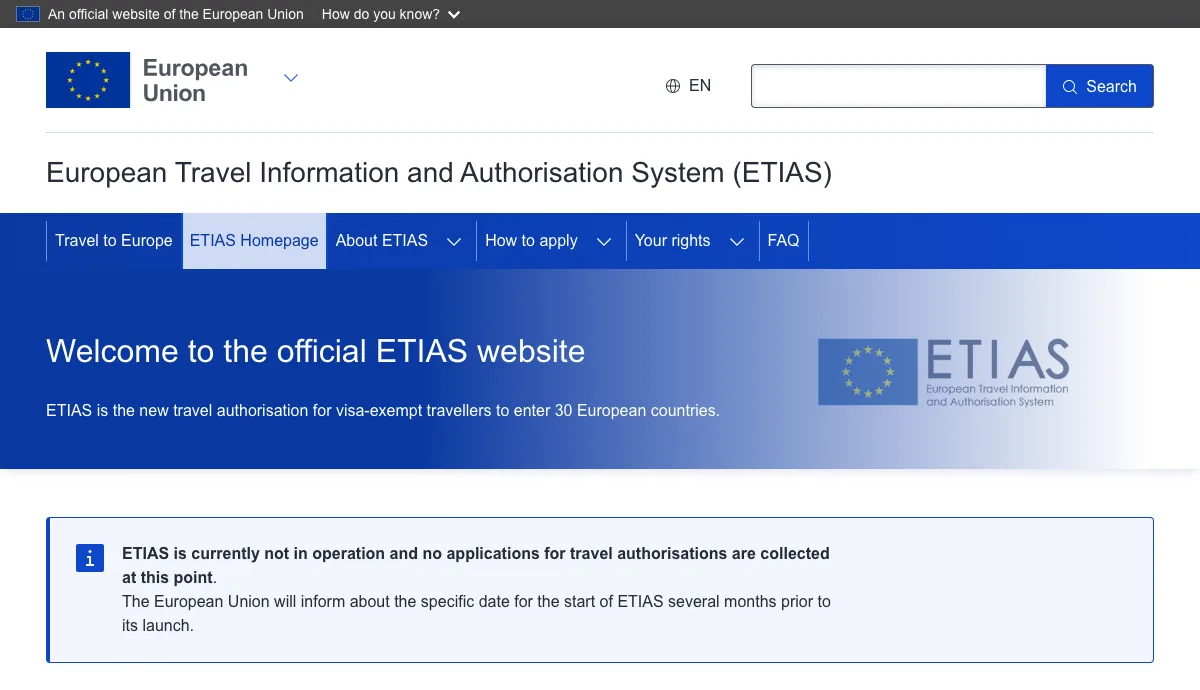
ETIAS isn’t in effect yet. As of November 16, 2026, the EU’s official ETIAS website says ETIAS is “currently not in operation and no applications for travel authorisations are collected at this point.” There’s no official start date. The EU says it will announce the date several months before ETIAS launches. Until then, you don’t need anything besides your U.S. passport for a short trip to the Schengen Area.
What does apply now is the Entry/Exit System (EES). Since April 10, 2026, it’s been fully operational at the external borders of the Schengen Area. On your first trip, border officials take your fingerprints and a photo of your face, and they no longer stamp your passport.
This guide explains both: what ETIAS will be and what the EU has said about it so far, how the EES works at the border, and how to avoid websites that already charge for ETIAS “applications.” For the general entry rules (passport validity, the 90/180-day rule, long stays), see the Europe visa page for U.S. citizens.
Key facts
- ETIAS today
- Not in operation. No applications are being collected, on the official website or anywhere else.
- Start date
- Not announced. The EU says it will give the date several months in advance.
- Planned fee
- €201. Applicants under 18 or over 70 will not pay it.
- Planned validity
- 3 years, or until your passport expires if that is sooner, for stays of up to 90 days in any 180.
- Countries
- 30 European countries: the 29 Schengen countries and Cyprus.
- EES
- Fully operational since April 10, 2026. Fingerprints and photo at the border on your first trip; no passport stamps.
Is ETIAS in effect now?
No. The official website, travel-europe.europa.eu/etias, says ETIAS isn’t in operation and that no applications are being collected. Its FAQ gives the same answer to “When does ETIAS enter into force?”
When does ETIAS start?
There’s no official date. The EU’s current position, repeated across the official website, is that it will announce the date “several months prior to its launch.”
Earlier, the EU was more specific. In news articles on the same website from July and September 2025, it said ETIAS would be required “starting from the last quarter of 2026,” and in December 2025 it said ETIAS would start “next year.” As of November 16, 2026, no start date has been announced, so treat any date you see elsewhere as a forecast, not a rule. We’ll update this guide when the EU announces the date.
Do Americans need ETIAS in 2026?
Not at the moment. For a short stay in the Schengen Area, your U.S. passport is enough; there’s nothing to apply for in advance. Once ETIAS starts, U.S. citizens will need it, because the United States is on the EU’s list of visa-exempt countries whose nationals have to apply.
What ETIAS will be
ETIAS (the European Travel Information and Authorisation System) is the EU’s planned travel authorization for travelers who don’t need a visa. It won’t be a visa. It will work like the UK’s ETA or the U.S. ESTA: an online application before your trip, linked to your passport.
According to the official website:
- Where: it will be required to enter 30 European countries: Austria, Belgium, Bulgaria, Croatia, Cyprus, Czechia, Denmark, Estonia, Finland, France, Germany, Greece, Hungary, Iceland, Italy, Latvia, Liechtenstein, Lithuania, Luxembourg, Malta, the Netherlands, Norway, Poland, Portugal, Romania, Slovakia, Slovenia, Spain, Sweden, and Switzerland. Ireland isn’t on the list.
- How to apply: only on the official website or the official ETIAS mobile app, once ETIAS starts, and not before.
- Fee: €20. Applicants under 18 or over 70 are exempt from the fee. The fee will be nonrefundable. In July 2025, the EU announced it was raising the planned fee from €7 to €20.
- Validity: 3 years, or until the passport you applied with expires, whichever comes first. With a new passport, you’ll need a new ETIAS. An ETIAS issued before age 18 will stay valid until it expires.
- Stays: as many trips as you want, for up to 90 days in any 180-day period. Time in Cyprus will be counted separately from the other 29 countries.
- Processing time: most applications will be processed within minutes. If not, you’ll get a decision within 4 days. That can be extended by up to 14 days if you’re asked for more information or documents, or by up to 30 days if you’re invited to an interview.
- Passport: it shouldn’t expire within 3 months or be more than 10 years old.
- What you’ll be asked: your personal details (including your parents’ first names), your home address, email, and phone number, your passport details, your education and current job, the country of your first intended stay, and questions about criminal convictions, travel to war or conflict zones, and whether you’ve recently been ordered to leave a European country (a “return decision”).
- Children: each traveler, including children, will need their own application. There won’t be group applications.
An approved ETIAS won’t guarantee entry. Border officials will still check your passport and that you meet the entry conditions.
Who won’t need ETIAS
You won’t need ETIAS if:
- You’re also a citizen of an EU country (including Ireland), Iceland, Liechtenstein, Norway, or Switzerland. The EU says dual nationals in this situation are exempt and must travel on that European passport. If you hold two passports from countries that both need ETIAS, you can choose which one to apply with, but you must travel with the same one.
- You hold a residence permit from one of the ETIAS countries other than Cyprus, or a residence card as the family member of an EU citizen from one of the 30 ETIAS countries or Ireland.
- You only stay in the international transit area of a European airport.
Family members of EU citizens have special rules and, in some cases, won’t pay the fee. See the ETIAS FAQ if this applies to you.
By plane, train, bus, or car
Once ETIAS starts, airlines and cruise lines will check that you have it before you board. The EU says bus companies will have 3 years from the start of ETIAS to begin checking, and train operators won’t have to check, so your ETIAS will be checked at the border instead. Trains from the UK, such as those from London St Pancras, will be the exception: border officials will check it before you board. If you drive, your ETIAS will be checked at the border crossing, and everyone in the car, including children, will need their own.
The EES: what happens at the border now
The Entry/Exit System (EES) is the EU’s digital system for recording when non-EU travelers enter and leave. It replaced passport stamps. It was rolled out gradually from October 12, 2025, and since April 10, 2026, it’s been fully operational at all external border crossings of the 29 Schengen countries, which all use it. Cyprus and Ireland don’t use the EES and still stamp passports.
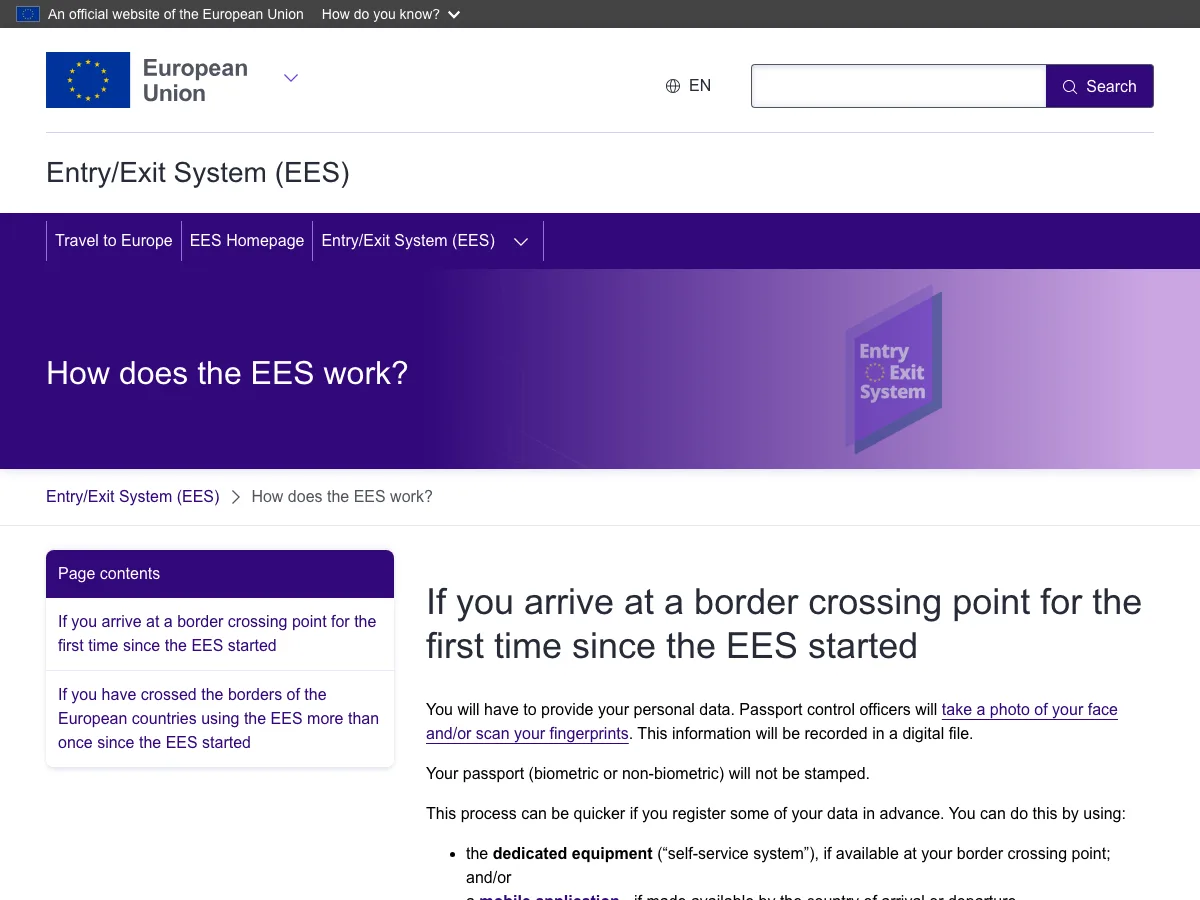
On your first trip since the EES started, border officials take a photo of your face, scan your fingerprints, or both, and record them with your passport details in a digital file. Your passport isn’t stamped, whether or not it’s biometric. The EU says that, in principle, you won’t be denied entry just because your passport isn’t biometric.
On later trips, border officials only check your fingerprints and photo, which is faster. With a biometric passport, you may be able to use a self-service kiosk where there is one.
Children under 12 aren’t fingerprinted.
To save time, you can enter some of your data yourself at a self-service kiosk at the border, if there is one, or in the EU’s Travel to Europe app up to 72 hours before you cross. As of November 16, 2026, the EU says the app works for entry to Sweden (passport data, photo, and entry questionnaire) and Portugal (entry questionnaire only). Using it is optional, and you still go through a border check.
The EES doesn’t apply to holders of a residence permit or long-stay visa, or to some family members of EU citizens, among others. Check the EU’s list of who the EES doesn’t apply to if you live in Europe.
The 90/180-day rule and the EES
The EES doesn’t change how long you can stay: up to 90 days in any 180-day period, counted together for all the countries that use it. What changes is that the system now counts your days automatically, and if you’ve already used your 90 days, you’ll be denied entry.
You can check how many days you have left with the EU’s online calculator, or ask a border official. The EU notes that the calculator doesn’t count time in the Schengen Area that began before April 10, 2026. For how the rule works, see the Europe visa page.
Websites that charge for ETIAS
If you search for ETIAS, you’ll find websites with “ETIAS” in their name that look official and offer to take your application or charge a fee. They aren’t the official website. The official one is on europa.eu, the EU’s domain: travel-europe.europa.eu/etias.
Here’s what the EU says:
- ETIAS isn’t in operation, and no applications are being collected at this point, so there’s nothing to apply for yet.
- There are many unofficial ETIAS websites. Some falsely claim to accept ETIAS applications or may charge higher fees.
- Once ETIAS starts, any other website that offers to apply for you will collect your data, use the official website to file your application, and may charge its own fee in addition to the €20. Applying directly will cost €20.
Once ETIAS starts, a travel agency or another person will be able to apply for you if you both sign a declaration of representation. You won’t need a third party to apply, and nobody can apply before ETIAS starts.
What you need for Europe today
For a short trip to the Schengen Area with a U.S. passport, as of November 16, 2026:
- No visa and no ETIAS. Nothing to apply for before you go.
- A passport that meets the EU’s rules: valid for at least 3 months after the day you plan to leave, and issued within the last 10 years. Details on the Europe visa page.
- Fingerprints and a photo at the border on your first trip under the EES.
- No more than 90 days in any 180 in the Schengen Area.
Frequently asked questions
Is ETIAS in effect now?
No. As of November 16, 2026, the official ETIAS website says ETIAS isn’t in operation and no applications are being collected.
What date is ETIAS starting?
There’s no official date yet. The EU says it will announce the start date several months before ETIAS launches. In 2025, it said ETIAS would start in the last quarter of 2026, but as of November 16, 2026, it hasn’t announced a date.
Do Americans need ETIAS in 2026?
Not at the moment, because ETIAS isn’t in operation. Once it starts, U.S. citizens will need it for short trips to 30 European countries.
Do I need an ETIAS now to travel to Europe?
No. For a short trip to the Schengen Area, you only need your U.S. passport. At the border, the EES records your fingerprints and photo.
How much will ETIAS cost?
€20, according to the official ETIAS website. Applicants under 18 or over 70 won’t have to pay.
How long will ETIAS be valid?
Three years, or until the passport you applied with expires, whichever comes first.
How long will it take to get ETIAS?
The EU says most applications will be processed within minutes and the rest within 4 days. That can be extended by up to 14 days if you’re asked for more information, or by up to 30 days if you’re invited to an interview.
What’s the official ETIAS website?
travel-europe.europa.eu/etias, on the EU’s europa.eu domain, plus the official ETIAS app once ETIAS starts. A website that takes ETIAS applications or payments today isn’t the official one.
I paid for ETIAS on a website. Is my application valid?
No. The EU says ETIAS isn’t in operation and no applications are being collected, so there’s no ETIAS to issue yet. Contact the website you paid and ask what it did with your payment.
Is ETIAS a visa?
No. It’s a travel authorization for people who don’t need a visa. It won’t let you work, study long-term, or stay longer than 90 days in any 180.
What is the EES?
It’s the Entry/Exit System, the EU’s digital system for recording when non-EU travelers enter and leave the Schengen Area. It has been fully operational since April 10, 2026, and replaced passport stamps.
Do I need to register for the EES before my trip?
No. You’re registered at the border on your first trip. In some countries, you can save time by pre-registering in the Travel to Europe app up to 72 hours before you cross.
Do children need ETIAS and the EES?
Once ETIAS starts, every child will need their own ETIAS, and travelers under 18 won’t pay the fee. Under the EES, children under 12 aren’t fingerprinted.
I’m a dual U.S. and EU citizen. Will I need ETIAS?
No. The EU says that if you’re also a citizen of an EU country (including Ireland), Iceland, Liechtenstein, Norway, or Switzerland, you’re exempt, and you must travel on that European passport.
Will I need ETIAS for a layover in Europe?
Not if you stay in the airport’s international transit area. If you leave it, you’ll need ETIAS once it starts.
Do I need ETIAS for the UK or Ireland?
No. Neither Ireland nor the UK is one of the 30 ETIAS countries. The UK has its own electronic travel authorization (ETA), which U.S. citizens need now.
What are the new rules for U.S. citizens traveling to Europe?
Since April 10, 2026, the EES records your fingerprints and photo at the border instead of stamping your passport. ETIAS will be the next change, but it hasn’t started yet. The 90/180-day rule hasn’t changed.
Apply yourself or use a visa service? Compare the government fee with what each visa service charges, online or in person, on the Europe (Schengen Area) visa page.
Sources
Where the information in this guide comes from, with the date we last checked it: official websites for fees and rules, and each visa service’s website or Google Maps listing when we give its prices or reviews. The numbers match the superscript numbers in the text.
- 1.European Union: ETIAS FAQ. travel-europe.europa.eu · checked on November 16, 2026
- 2.European Union: Travel to Europe, official ETIAS website (homepage). travel-europe.europa.eu · checked on November 16, 2026
- 3.European Union: What is ETIAS (validity, fee, processing time). travel-europe.europa.eu · checked on November 16, 2026
- 4.European Union: Who should apply for ETIAS (30 countries and visa-exempt nationalities). travel-europe.europa.eu · checked on November 16, 2026
- 5.European Union: What you need to apply for ETIAS. travel-europe.europa.eu · checked on November 16, 2026
- 6.European Union: ETIAS will cost EUR 20 (news article, July 21, 2025). travel-europe.europa.eu · checked on November 16, 2026
- 7.European Union: Dual citizenship and ETIAS (news article, September 15, 2025). travel-europe.europa.eu · checked on November 16, 2026
- 8.European Union: Travelling to Europe with ETIAS by land (news article, December 18, 2025). travel-europe.europa.eu · checked on November 16, 2026
- 9.European Union: 5 things travel agents should know about ETIAS (news article, July 6, 2026). travel-europe.europa.eu · checked on November 16, 2026
- 10.European Union: What is the EES?. travel-europe.europa.eu · checked on November 16, 2026
- 11.European Union: How does the EES work?. travel-europe.europa.eu · checked on November 16, 2026
- 12.European Union: EES FAQ. travel-europe.europa.eu · checked on November 16, 2026
- 13.European Union: To whom does the EES not apply?. travel-europe.europa.eu · checked on November 16, 2026
- 14.European Union: Check how long you can stay (EES). travel-europe.europa.eu · checked on November 16, 2026
- 15.European Union: Travel to Europe mobile app (EES). travel-europe.europa.eu · checked on November 16, 2026