You apply for India’s e-Visa on one website: indianvisaonline.gov.in/evisa, run by India’s Bureau of Immigration. There’s no appointment at the High Commission or at VFS Global, and you don’t need a visa agency. This guide walks you through the official online application with an Australian passport: the fees for Australians, what each page of the form asks, the photo and passport scan the website accepts, and when you need a regular visa through VFS Global instead.
To compare the e-Visa with the other ways to get a visa for India, see India visa for Australians.
Watch out for copycat websites. Search for ‘India e-Visa’ and many of the top results are private websites with official-looking names. They charge much more than the government fee. India’s own website says e-Visa services are completely online, that no intermediary is needed, and that you shouldn’t share your personal details with any unauthorised website. Smartraveller also warns about fake websites offering e-Visa services. The official address ends in .gov.in.
Key facts
- Where
- Only on indianvisaonline.gov.in/evisa, the Government of India’s website.
- 30-day e-Tourist Visa
- US$10–251 (about A$14 to A$36): the lower fee from April to June, the higher one the rest of the year. 30 days from arrival, multiple entries2.
- 1-year e-Tourist Visa
- US$401 (about A$57). 1 year from approval, multiple entries; up to 180 days per calendar year2.
- 5-year e-Tourist Visa
- US$2001 (about A$284). 5 years from approval, multiple entries; up to 180 days per calendar year2.
- Bank charge
- 3% on top of the e-Visa fee. There’s no other government fee, and the fee isn’t refunded, even if your application is refused.
- When to apply
- Apply at least 4 days before arrival2, and no more than 120 days ahead. India doesn’t publish a processing time.
- What you get
- An Electronic Travel Authorization (ETA) by email. You print it, and an immigration officer puts the visa in your passport when you arrive.
Do Australians need a visa for India?
Yes. Smartraveller says you must apply for a visa before you arrive, and you can’t get a visa on arrival. The only exception is if you hold an Overseas Citizen of India (OCI) card.
The e-Visa is the usual choice if you’re visiting India for a holiday, to see friends or family, for a short yoga program or course, or for business. The e-Visa also covers medical treatment and conferences, each with its own type. For a single trip, the 30-day e-Tourist Visa is usually enough; the 1-year and 5-year ones allow several trips, with a stay of up to 180 days in each calendar year.
You need a regular (paper) visa instead to work, for journalism, for a long stay, or for a visa type that isn’t available as an e-Visa. The e-Visa can’t be extended or converted to another type of visa once you’re in India, and it isn’t valid for protected, restricted or cantonment areas, which need a separate permit. How to apply for a regular visa in Australia is explained below, under e-Visa or VFS Global?.
You don’t need a visa at all if you hold an OCI card. You can apply for one if you, a parent, a grandparent or a great-grandparent were an Indian citizen. You can use the electronic OCI card (e-OCI) with your valid Australian passport at Indian immigration. Smartraveller says you must update your details on the OCI portal every time you get a new Australian passport.
e-Visa or VFS Global?
Many people search for ‘VFS Global India’ when they only need the e-Visa. The two are separate:
- The e-Visa is completely online, on indianvisaonline.gov.in. You don’t go to VFS Global, the High Commission or a consulate. The Consulates-General of India in Sydney and Melbourne say e-Tourist Visa applications are processed directly in India, so they can’t tell you the status of yours.
- A regular (paper) visa goes through the Indian Consular Application Centres (ICACs) that VFS Global runs for the High Commission of India in Canberra and the Consulates-General of India. There are centres in Adelaide, Brisbane, Canberra, Melbourne, Perth and Sydney, open Monday to Friday, 8:30 am to 5 pm. You fill in the online government application form, book an appointment (appointments are required at all centres), then hand in your application and documents. The centre takes your fingerprints and photo.
For addresses and opening hours, see visa centres in Australia and High Commission of India, Canberra.
If you’re of Pakistani origin
Check this before you start:
- You can’t get an e-Visa if you hold a Pakistani passport, or if you, your parents or your grandparents were born in or lived permanently in Pakistan. The form asks about this, and India’s website says you can apply for a regular visa at an Indian mission instead.
- Apply for a regular visa through an Indian Consular Application Centre in Australia, and allow plenty of time.
- Smartraveller advises people of Pakistani origin to familiarise themselves with the Indian authorities’ visa requirements, as these could affect the application, and to contact the nearest Indian embassy or consulate.
- You can’t get an OCI card if you, your parents, grandparents or great-grandparents were ever citizens of Pakistan or Bangladesh.
Before you start
Have these ready:
- The passport you’ll travel with, valid for at least 6 months after the day you arrive in India and with at least 2 blank pages. Children need their own passport and their own e-Visa.
- A digital photo in JPEG format, between 10 KB and 1 MB, and square (the same height and width). Full face, from the front, eyes open, without glasses, on a plain white or light background, with no shadows and no border. The official sample form adds a minimum size of 350 × 350 pixels. Don’t crop it from your passport’s photo page.
- A scan of your passport’s photo page as a PDF between 10 KB and 300 KB, from the same passport you enter in the form.
- Your travel details: the airport or seaport where you’ll land, your expected arrival date, the places you plan to visit and the port where you plan to leave.
- Two references, each with an address and phone number: one in India, and one in Australia to contact in an emergency.
- Your parents’ names, nationalities and places of birth, and the countries you’ve visited in the last 10 years.
- A debit or credit card, or a PayPal account.
India’s Consulate-General in Sydney says the whole process, including payment, takes about 10 to 15 minutes once you have everything ready. Two things to watch: dates are written DD/MM/YYYY, as in Australia, and your name must be exactly as in your passport. The form warns that a visa may not be granted if the names don’t match.
Step 1: Open the official website
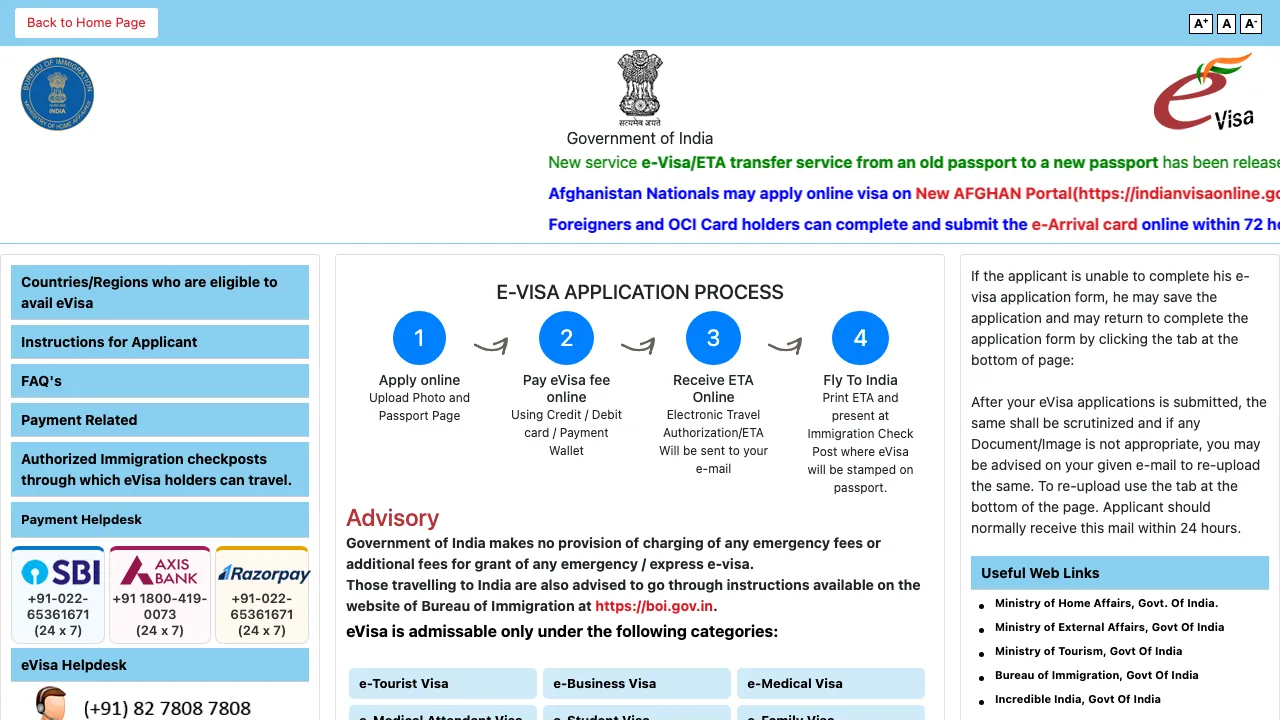
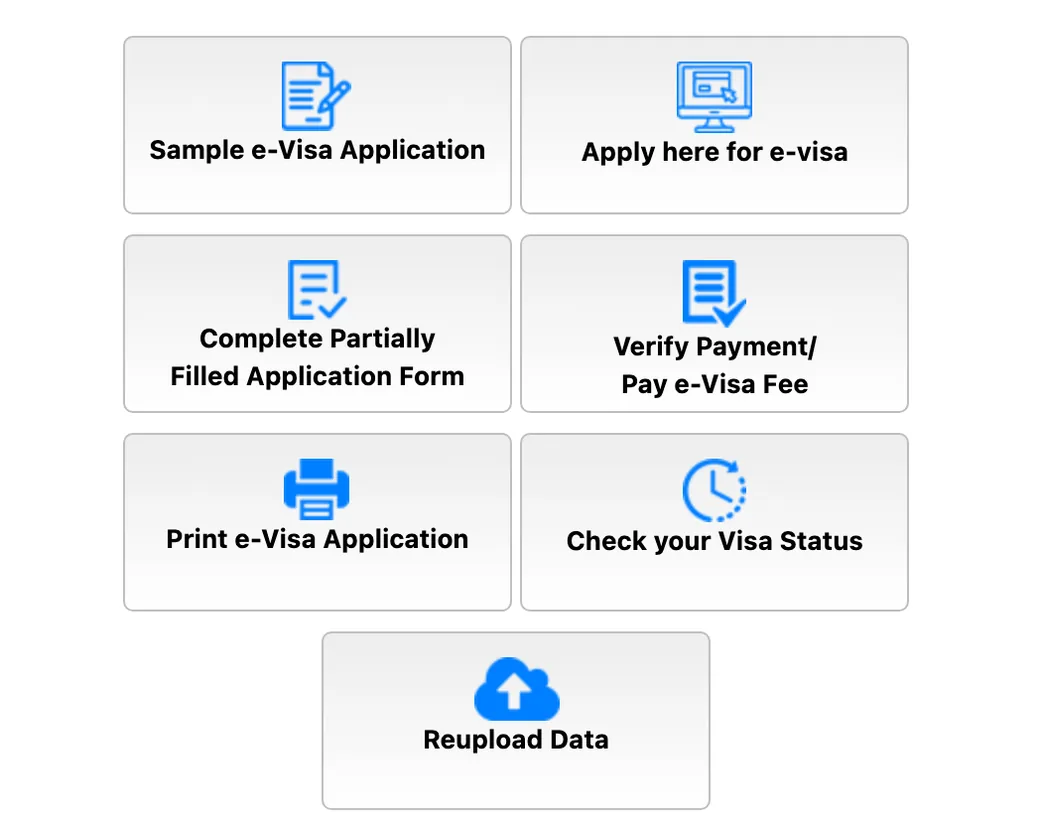
Go to indianvisaonline.gov.in/evisa (the home page is in the image at the top of this guide). The menu has the list of eligible countries, the instructions, the FAQs, payment information and the airports and seaports where you can enter with an e-Visa. The home page sums up the process in four steps.
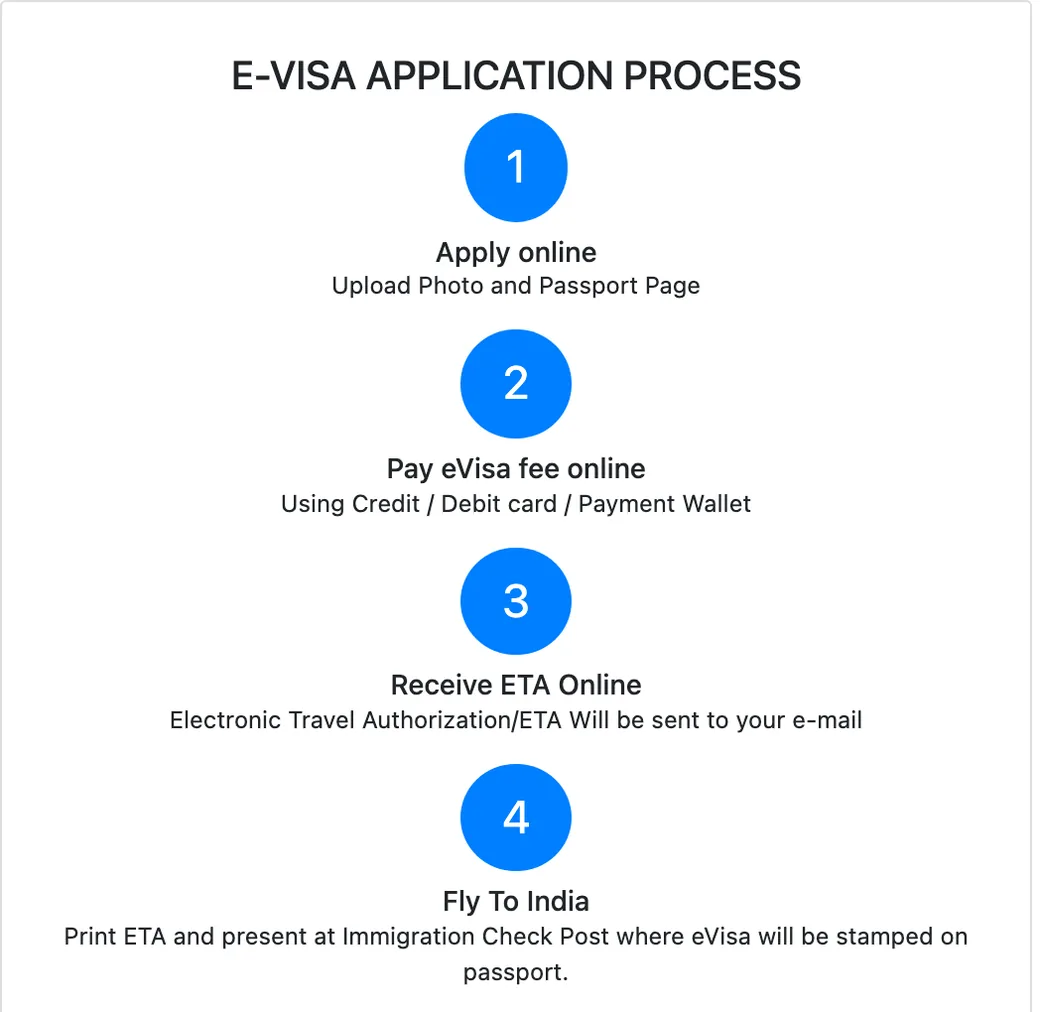
Scroll to the bottom and click Apply here for e-visa. The other buttons there are the ones you’ll need later: to finish a saved application, to pay or check a payment, to print your application, to check your visa status and to re-upload a document if you’re asked to.
Step 2: Passport number, country and the health question
A small window opens first:
- Passport No: your passport number, with no spaces.
- Select Country/Region: choose Australia from the list.
- Name as in passport: your full name, letters and spaces only.
Click Continue. The website then asks whether you’ve visited the Democratic Republic of the Congo in the last 21 days. If you answer No, the application form opens.
Step 3: The first page of the form
| Field | What to enter |
|---|---|
| Nationality/Region | Australia. Confirm it when the website asks |
| Passport Type | ORDINARY PASSPORT |
| Port Of Arrival | The airport or seaport where you’ll land, such as Delhi or Mumbai airport. With an e-Visa, you can only enter through the airports and seaports on the official list, not by land |
| Date of Birth | DD/MM/YYYY |
| Email ID | An address you check often: your confirmation and ETA are sent there |
| Visiting India for | The purpose of your trip. It sets the e-Visa type and the fee: for a holiday, choose the 30-day, 1-year or 5-year e-Tourist Visa |
| Expected Date of Arrival | DD/MM/YYYY. At least 4 days and no more than 120 days from today |
Type the characters from the image, tick the box confirming that you’ve read the instructions, and click Continue.
Step 4: The rest of the form
You then get a Temporary Application ID: write it down. Each page has Save and Continue and Save and Temporarily Exit; you can come back with Complete Partially Filled Application Form on the home page. If you close the page without saving, you lose what you typed.
India’s official sample application shows the remaining pages (it dates from 2019, so some fields may look slightly different):
- Applicant details: surname and given names exactly as in your passport, any previous names, sex, town and country of birth, national ID number (the form says to type NA if it doesn’t apply), religion, visible identification marks, education, and whether you became a citizen by birth or naturalisation. Then your passport details, and any other passport you hold.
- Address and family: your home address, phone number, your father’s and mother’s names, nationalities and places of birth, your marital status, and whether your parents or grandparents were Pakistani nationals.
- Visa details: places you’ll visit, the port where you’ll leave, any previous visits to India, the countries you’ve visited in the last 10 years, visits to other South Asian (SAARC) countries in the last 3 years, and your two references.
- Additional questions: yes-or-no questions about arrests, deportations and serious crimes, then a declaration that your answers are true.
- Photo upload and 6. Document upload: the photo and passport scan described above. All documents must be in English.
- Confirm details: a summary of everything you entered. India’s FAQ says you’re responsible for any mistake in your name, nationality, passport number, date of birth or photo, so check it carefully before you click Verified and Continue.
Step 5: Pay the fee
The last page shows your Application ID. You accept that the fee is non-refundable, then choose Pay Now or Pay Later. With Pay Later, your application isn’t submitted until you pay, and you must pay at least 4 days before you travel.
You pay in US dollars by debit or credit card or PayPal, with the 3% bank charge added. The amount in Australian dollars depends on your bank’s exchange rate and any international transaction fee. Your bank may ask you to confirm the payment.
If the payment seems to fail, don’t pay again straight away. The website says the payment status can take up to 2 hours to update. Check it first with Verify Payment/Pay e-Visa Fee.
After you apply
- You get a confirmation email when you submit and pay.
- The website may ask you to re-upload your photo or passport scan if they don’t meet the requirements. Use Reupload Data on the home page.
- You get the decision by email. To check it yourself, use Check your Visa Status with your Application ID and passport number. Before you travel, make sure the status shows GRANTED.
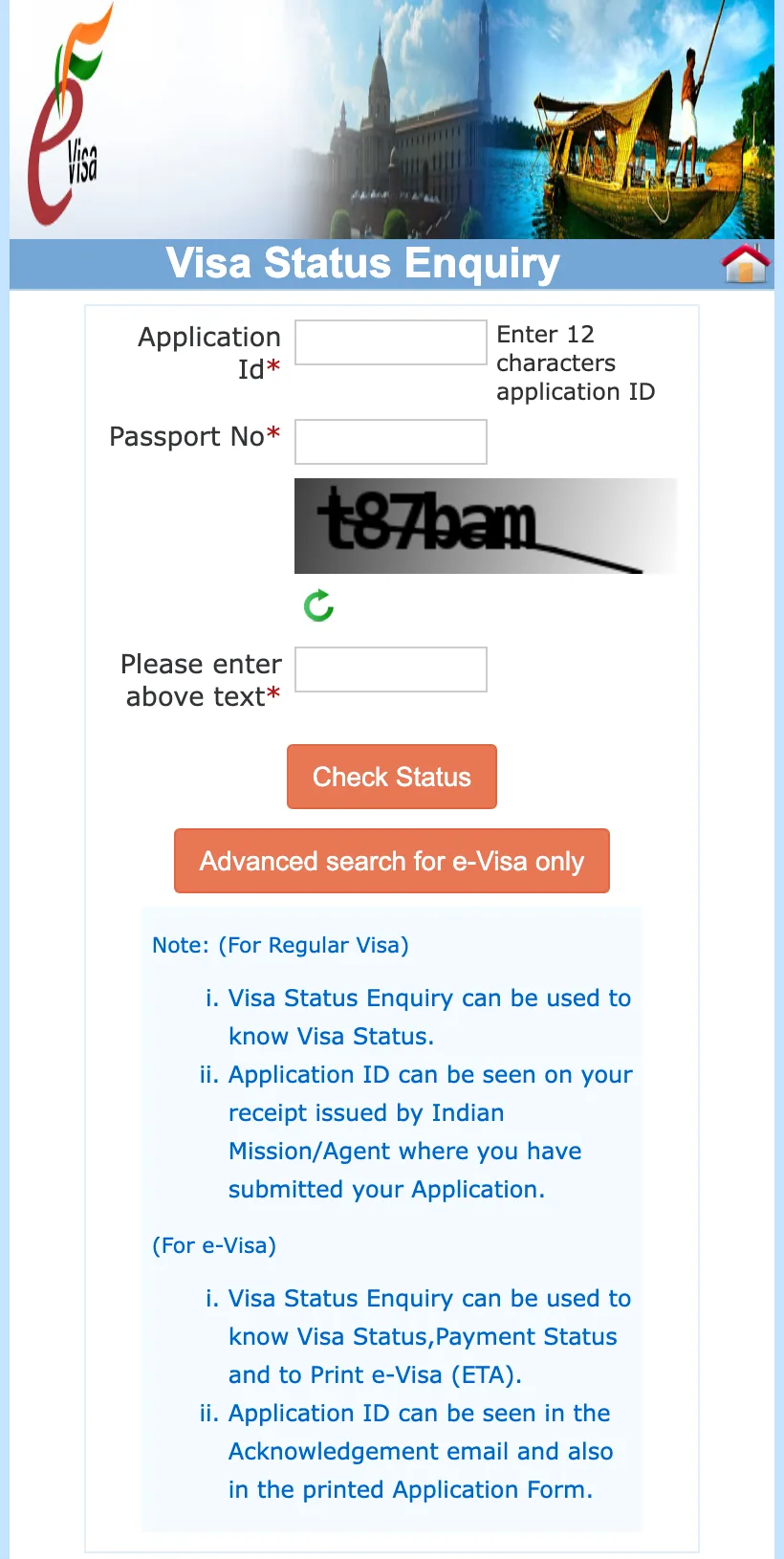
- Print your ETA and carry it with your passport. Travel on the passport you applied with. If you get a new passport after your ETA is issued, India’s Consulate-General in Sydney says you can enter on the new one as long as you also carry the old passport.
- Complete the free e-Arrival Card up to 3 days before you travel, on indianvisaonline.gov.in/earrival or in the Indian Visa Su-Swagatam app. It isn’t a visa. Smartraveller says you also need to complete an online health self-declaration form up to 24 hours before you arrive, for Ebola screening.
- At immigration, an officer checks your ETA and puts the visa in your passport. Smartraveller says you may have your fingerprints and photo taken at some larger airports, and that long queues are common.
Questions about your application? Contact India’s e-Visa helpline: +91 827808 7808 or +91 11 24300666, or indian-evisa@gov.in. The Consulates-General of India in Sydney and Melbourne also refer e-Tourist Visa questions to +91 11 24300666.
What Smartraveller says about India
Smartraveller’s advice for India is ‘Exercise a high degree of caution’, with higher levels in some areas (updated 29 October 2026; checked 26 November 2026). On visas and entry, it says:
- get your e-Visa before you travel: there’s no visa on arrival;
- carry a printed copy of your ETA;
- not all international airports in India accept the e-Visa. If you arrive with an e-Visa where it isn’t recognised, you can’t apply for another visa, you won’t be allowed to enter and you’ll be deported;
- you can leave India through any authorised immigration checkpoint, but all land crossings between India and Pakistan are closed;
- if you leave India on a different passport from the one you entered on, including an emergency passport, you need a special exit permit from the Foreigners Regional Registration Office (FRRO), which can take 2 weeks or more.
For safety, health and local laws, see the full Smartraveller advice for India and our India visa page.
Do it yourself or use a visa agency?
You can do it yourself: the form is long, but it’s all online, and India says no intermediary is needed. A visa agency can fill in or check the application for you, for its own fee on top of the government fee. It can help if the website keeps rejecting your photo or card, or if you’re applying for a whole family. Here’s what the online visa agencies in our directory charge for the 30-day e-Tourist Visa:
- Official website (no agency)US$10–251 government fee
- Atlys· OnlineIndia e-Tourist Visa (30 days, multiple entry)A$112.33
- Sherpa· OnlineIndia e-Tourist Visa (30 days, multiple entry)A$113.53
- VisaHQ· OnlineIndia e-Tourist Visa (30 days, multiple entry)A$128.09
- iVisa· OnlineIndia e-Tourist Visa (30 days, multiple entry)A$189.95
Total price per person shown by each agency on its website, government fee included, with standard processing, for an Australian passport; checked on 27 November 2026. Prices change, so check them before you pay. Each price and its source are on the agency’s page. Full entry requirements for India.
Common mistakes
- Applying on a copycat website. Check that the address ends in .gov.in.
- Booking a VFS Global appointment for an e-Visa. The e-Visa is online only; VFS Global handles regular visas.
- Applying for an e-Visa if you’re of Pakistani origin. You need a regular visa.
- A name that doesn’t match your passport, or surname and given names swapped.
- Applying too early or too late: at least 4 days and no more than 120 days before you arrive.
- A photo that isn’t square, is too large, has a dark background or shows you wearing glasses.
- A passport scan saved as an image instead of a PDF, or larger than 300 KB.
- The wrong purpose in ‘Visiting India for’, which sets your e-Visa type and fee.
- Paying twice because the payment status hasn’t updated yet.
- Planning to enter by land or at an airport that isn’t on the e-Visa list.
Frequently asked questions
Do Australians need a visa for India?
Yes, unless you hold an OCI card. There’s no visa on arrival. Most Australian visitors apply for the e-Visa online. If you’re of Pakistani origin, or you need a visa that isn’t available as an e-Visa, you apply for a regular visa through an Indian Consular Application Centre run by VFS Global.
How much is an India e-Visa for Australians?
The e-Tourist Visa costs US$10–25 for 30 days (about A$14 to A$36; the lower fee from April to June), US$40 (about A$57) for 1 year and US$200 (about A$284) for 5 years, plus a 3% bank charge. If you use a visa agency, its fee is extra.
Can I apply for an Indian visa online?
Yes. You apply and pay for the e-Visa entirely online, on indianvisaonline.gov.in. A regular (paper) visa also starts with an online form, but you then hand in your application at a VFS Global centre by appointment.
Do I need to go to VFS Global for an India e-Visa?
No. VFS Global’s Indian Consular Application Centres handle regular visas, OCI cards and other consular services, not the e-Visa.
How far in advance should I apply for an Indian e-Visa?
No later than 4 days and no earlier than 120 days before you arrive. India doesn’t publish a processing time, so apply as soon as you know your dates.
How long does an Indian e-Visa take?
India doesn’t publish an official processing time for the e-Visa. You get a confirmation when you apply and the decision by email. Check that your status shows GRANTED before you travel.
Can I enter India at any airport with an e-Visa?
No. You must arrive at one of the designated airports or seaports on the official list. You can leave through any authorised immigration checkpoint.
Do I need to print the e-Visa?
Yes. The official website and Smartraveller say to carry a printed copy of your ETA, the approval sent by email.
Can I get a refund if my e-Visa is refused?
No. The fee is non-refundable, whether your e-Visa is granted or refused, or you cancel your trip.
Do children need their own e-Visa?
Yes. Each child needs a separate e-Visa, and their passport must be valid for at least 6 months from the day they arrive in India.
I live in Australia but I’m not an Australian citizen. Does this guide apply to me?
The steps are the same, but the fee and eligibility depend on your nationality. Check them on the official website.
Is Visania an official website?
No. Visania is an independent guide. Apply only on indianvisaonline.gov.in, India’s official e-Visa website.
Apply yourself or use a visa service? Compare the government fee with what each visa service charges, online or in person, on the India visa page.
Sources
Where the information in this guide comes from, with the date we last checked it: official websites for fees and rules, and each visa service’s website or Google Maps listing when we give its prices or reviews. The numbers match the superscript numbers in the text.
- 1.e-Tourist Visa fees by country (Government of India, PDF). indianvisaonline.gov.in · checked on 18 November 2026
- 2.Indian Visa Online: official e-Visa website, with instructions, FAQs and payment information (Government of India). indianvisaonline.gov.in · checked on 18 November 2026
- 3.Indian Visa Online: sample e-Visa application (Government of India, PDF). indianvisaonline.gov.in · checked on 16 November 2026
- 4.Indian Visa Online: Visa Status Enquiry (Government of India). indianvisaonline.gov.in · checked on 16 November 2026
- 5.e-Arrival Card (Bureau of Immigration, India). indianvisaonline.gov.in · checked on 16 November 2026
- 6.OCI Services: eligibility (Ministry of Home Affairs, India). ociservices.gov.in · checked on 12 November 2026
- 7.Consulate-General of India in Sydney: e-Visa. cgisydney.gov.in · checked on 26 November 2026
- 8.Consulate-General of India in Sydney: contact us (e-Tourist Visa enquiries). cgisydney.gov.in · checked on 27 November 2026
- 9.VFS Global: Indian Consular Application Centres in Australia. visa.vfsglobal.com · checked on 27 November 2026
- 10.Smartraveller: India travel advice (Department of Foreign Affairs and Trade). smartraveller.gov.au · checked on 26 November 2026
- 11.Reserve Bank of Australia: exchange rates, table F11.1 (Australian dollar equivalents). rba.gov.au · checked on 26 November 2026